Showing posts with label math. Show all posts

Every student can be a S.T.A.R. Problem Solver

Every student can be a STAR math problem solver.  If you hate hearing the moans and groans every time your students have to solve word problems you need to read this blog post!  Find out how to help all your students master math word problem strategies and become STAR problem solvers!

With the right tools, every student can be a star with problem solving.  You just need to show them how to read and understand the problem, much like you teach comprehension during your reading lessons.  

Using the I do it, we do it, you do it  model I first teach the 4 steps to problem solving.

I do it-  I read the word problem and do my thinking out loud so the whole class can hear my thoughts and the questions I'm asking myself. I show them how I figure out what the story problem is asking and how to pull out the important information.  Then I model one of the problem solving strategies, find the solution and most importantly, go back to review and check my answer.

We do it- First I'll read the problem and ask some of the thinking aloud questions and let the students respond. Gradually, I'll lead them to do the think aloud part.  After we've figured out what the problem is asking and pulled out the important information we'll choose a strategy and solve the problem.  I may have them solve the problem with a partner or on their own.  Then we share solutions, making sure to discuss that there is usually more than one way to solve a problem.  We always end with a review and answer check, which I consider one of the most important steps in this process. 

You do it- After several days of doing the problems together, the students are ready to solve a word problem on their own.  At first they'll need visual and verbal cues for the steps, but gradually, these steps should become automatic.  I like to begin the "You do it" phase with partners and move on to individual work later. 

The problem solving steps follow the acronym-STAR 

Stop and read the problem
Think about a strategy
Act, or carry out the strategy and solve the problem
Review the problem and check your answer
(You can download this free poster to introduce the STAR steps.)
Every student can be a STAR math problem solver.  If you hate hearing the moans and groans every time your students have to solve word problems you need to read this blog post!  Find out how to help all your students master math word problem strategies and become STAR problem solvers!

I teach the kids eight basic strategies that are used with the STAR steps. I usually follow this order;

  • use manipulatives
  • draw a picture
  • make an organized list
  • find a pattern
  • make a table or chart
  • guess and check
  • use logical reasoning
  • work backwards
I think the easiest strategy to begin with is using manipulatives.  This is a very concrete way for students to visualize what is going on in the problem.  The manipulatives can be little blocks, teddy bear counters, clocks, coins or anything that can be moved around to "act out" the problem.

After using manipulatives I usually teach the strategy draw a picture. I think this strategy is my favorite.  I'm a visual learning and sketching out the information helps me make sense of the problem.

The other strategies can be taught in any order.  I do suggest that you spend several days or a week on each strategy before introducing a new one.   Most problems can be solved in multiple ways.  Some kids will even use parts of two or three different strategies to solve a problem.  One thing I require is that they be able to explain their thinking. They need to be able to tell what they did and why.

I only teach one strategy at a time.  Depending on my group of students and their previous experience with these steps and strategies I'll spend about a week on each strategy.  These strategies will help students solve almost any word problem they will ever come across.  I don't teach key words.  Not all word problems have key words and not all word problems require an addition, subtraction, multiplication or division equation.

Some strategies work better with certain problems, but most word problems can be solved using several different strategies.  After the students are familiar with 2 or 3 strategies I'll have several days where I'll give them a few problems and let them choose the strategy they want to solve the problem.  I love it when students use different strategies and they all come up with the same answer!

We always take time to share our strategies and thinking.  I also ask them why they chose a certain strategy.  Sharing their thinking aloud is very important because it lets the students who may be struggling have a "peek" inside their brains!



1


your photo name

Snow Much Fun with Elapsed Time!

Three Strategies for Figuring Elapsed Time
Elapsed time doesn't have to be so complicated.  Show your students how to figure elapsed time without stressing them out!  Even better, there's a freebie here.

One of the most difficult skills with telling time is measuring elapsed time.  Even as an adult I find myself counting the hours and minutes aloud just to make sure I do it correctly.

I show my students three different strategies to measure elapsed time.  I don't know that one strategy is any better than the others. I like to give kids several choices and then let them use the method that works best for them.

Strategy 1  Use a clock face.  I usually start with this strategy because it uses a clock face and kids can see that the minutes from one hour flow into the next hour when figuring elapsed time.  This works best if the elapsed time is less than an hour.  If the kids are counting elapsed time and end up with 75 minutes you'll have to show them how to convert 75 minutes into hours and minutes.

As this chart shows the student starts at the first time and then count the minutes to the ending time.  If the starting time is not on a 5 minute interval that I usually have the students count by ones to get to the 5 minute and then they can more easily count by 5s. For example:  How long is it from 3:32 to 3: 50? "3:33, 3:34, 3:35, 3:40, 3:45, 3:50. That would be 18 minutes." (It's easier to see on a clock face.)  Another tip is to have a worksheet the kids can mark on with their pencil.  That way they can draw the little "hopping" marks to then count the minutes.


Elapsed time doesn't have to be so complicated.  Show your students how to figure elapsed time without stressing them out!  Even better, there's a freebie here.


Strategy 2  Use a flat number line. A clock is a type of number line but when figuring elapsed time that is more than an hour using a flat number line may be easier.  Begin with the beginning time.  Draw a large jump (mountain) to jump into the next hour.  In this example we jumped from 1:47 to 2:47.  Kids will need to understand when jumping ahead one hour only changes the hour, the minutes don't change yet.  When the hour jumps gets you into the needed hour, begin counting the minutes. Again, I ask students to count the single minutes to get to a five minute interval.  Keep jumping ahead by 5s until you can't jump anymore without going past the time.  You may need to jump more single minutes to get to the ending time.  Finally, count up the hours and minutes to know the elapsed time.

Elapsed time doesn't have to be so complicated.  Show your students how to figure elapsed time without stressing them out!  Even better, there's a freebie here.

Strategy 3  Use a T Chart.   I find this works well if kids have a good understanding of time.  Write the starting time on the right. On the left you'll be keeping track of the elapsing hours and minutes. Advance by hours first, then 30 minutes, 15 minutes, 5 minutes and single minutes. If your students can only count in 5 and 1 minute intervals this strategy will still work, the T Chart will just be longer.

Elapsed time doesn't have to be so complicated.  Show your students how to figure elapsed time without stressing them out!  Even better, there's a freebie here.


Here's a free download to begin showing your students how to figure elapsed time.   
 Free posters for teaching the strategies for figuring elapsed time from Crockett's Classroom


 The full version of Snow Much Fun with Time is available from Crockett's Classroom on TPT.

 Snow Much Fun with Time, telling time activities from Crockett's Classroom

Show your students how to figure elapsed time without stressing them out!  Crockett's Classroom

Show your students how to figure elapsed time without stressing them out!  Crockett's Classroom

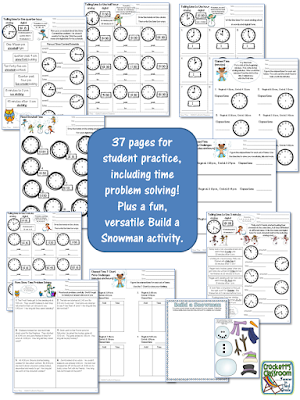
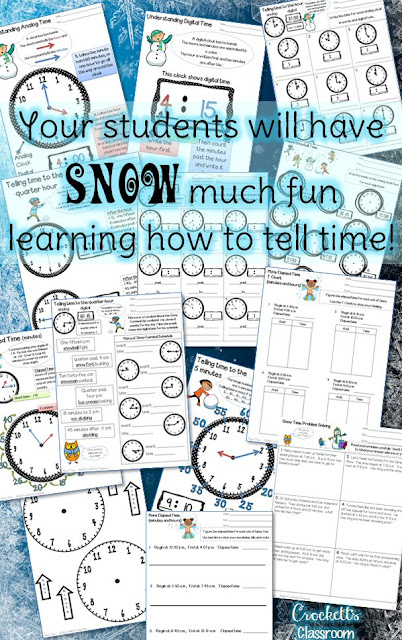
Time to teach telling time to your students!  They'll have "snow" much fun learning to tell time to the hour, half hour, quarter hour, 5-minute and 1-minute intervals with this packet.  Tons of practice pages and student reference sheets to use with your lessons.


0


your photo name

Cozy Geometry Quilts

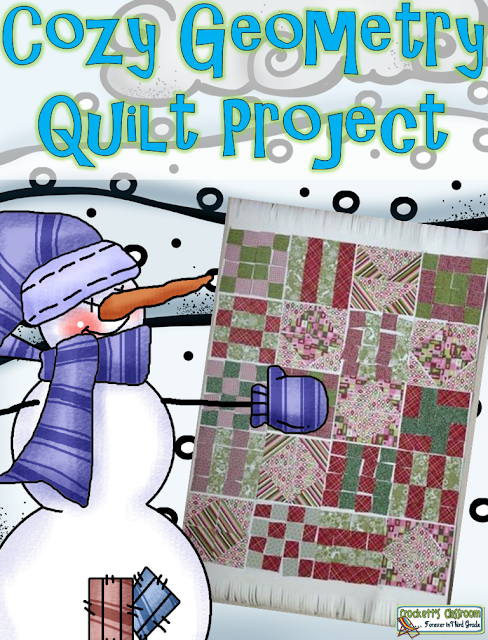
Cozy up with this engaging activity that helps your students  review geometry concepts.

Brrrr!  It's cold outside!  Time to get out the quilt and have a little fun with geometry.  I have a great project that can be done with any geometry unit.  

A few weeks ago I spent a couple of afternoons with a super class of second graders and helped them review some geometry concepts as we put together paper quilt calendars for the new year.

Before I started the lesson I cut 4 inch squares from some holiday scrapbook paper.  We did this project in December so I chose red and green paper, but you can do this with any scrapbook paper you have on hand. 
Getting the pieces ready for our class geometry quilt.

Let each student choose 4 squares, 2 of one color/pattern, 2 of another color/pattern.  Then we cut the squares into rectangles and then the rectangles into smaller squares.  Each student should end up with 16 small squares.  While we were cutting I was reviewing geometry terms.

Now,  let them explore making patters.  I was arranging my own pieces on the board so they begin by making my pattern.  But, they soon began creating their own patterns.  

After a little while I asked them to choose one pattern they liked the best and glue it onto the quilt back.  The results were beautiful!
The kids had so much fun making these paper quilts.It was also a great way to review geometry.

 The next day I returned to their class and went through the same procedures but we used triangles cut from the squares.  The kids made some amazing quilts!


The kids had so much fun making these paper quilts.It was also a great way to review geometry.

Since the students had created 2 quilts they got to choose one to turn into a 2016 calendar.  The second one was put into a class display.


Make a paper quilt with your class, fun way to review geometry.

You can download the directions for making the quilt with the square pieces here: 


 Make a cozy quilt with your students to review geometry concepts.

0


your photo name

Math Facts Fluency


What exactly is math fact fluency?  It isn't about speed as many people beleve.  NCTM President Linda M. Goja summed it up this way in a 2012 article, Fluency: Simply Fast and Accurate? I Think Not!

"Focusing on efficiency rather than speed means valuing students’ ability to use strategic thinking to carry out a computation without being hindered by many unnecessary or confusing steps in the solution process. Accuracy extends beyond just getting the correct answer. It involves considering the meaning of an operation, recording work carefully, and asking oneself whether the solution is reasonable."

Your weekly math routine should include strategy lessons as well as time to practice basic facts.  If you choose to use timed drills, the time should be long enough for students to apply the strategies they're learning. (And I don't consider counting on your fingers as a strategy!)  With practice, the facts will become more automatic as students apply the strategies more quickly.

Here are some strategies that worked well in my classroom:
1. Zero rule, 3 + 0 = 3 / 5 - 0 = 5  and 6 X 0 = 0 / 8 ÷ 0 = 0
2. Counting up or backwards, works well when adding or subtracting by 1 or 2
3. Ones' rule for multiplication and division, 6 X 1 = 6 / 9 ÷ 1 = 9
4.  Fact Families, works well because students learn the relationship between addition/subtraction and multiplication/division.
5. Doubles, kids love to memorize these facts.  9 X 9 = 81 is always their favorite!
6.  Nines,  since nine is just one away from 10 there are some nifty tricks to add, subtract, multiply and divide by 9.
7. Numbers with zero in the ones place.  Kids should quickly see that 7 + 10 = 17 and 14 - 10 = 4.

I know there are many more fact strategies and you probably have a few of your own favorites.  I'd love to hear what works in your class.  Please share your favorite strategies in the comments section below.

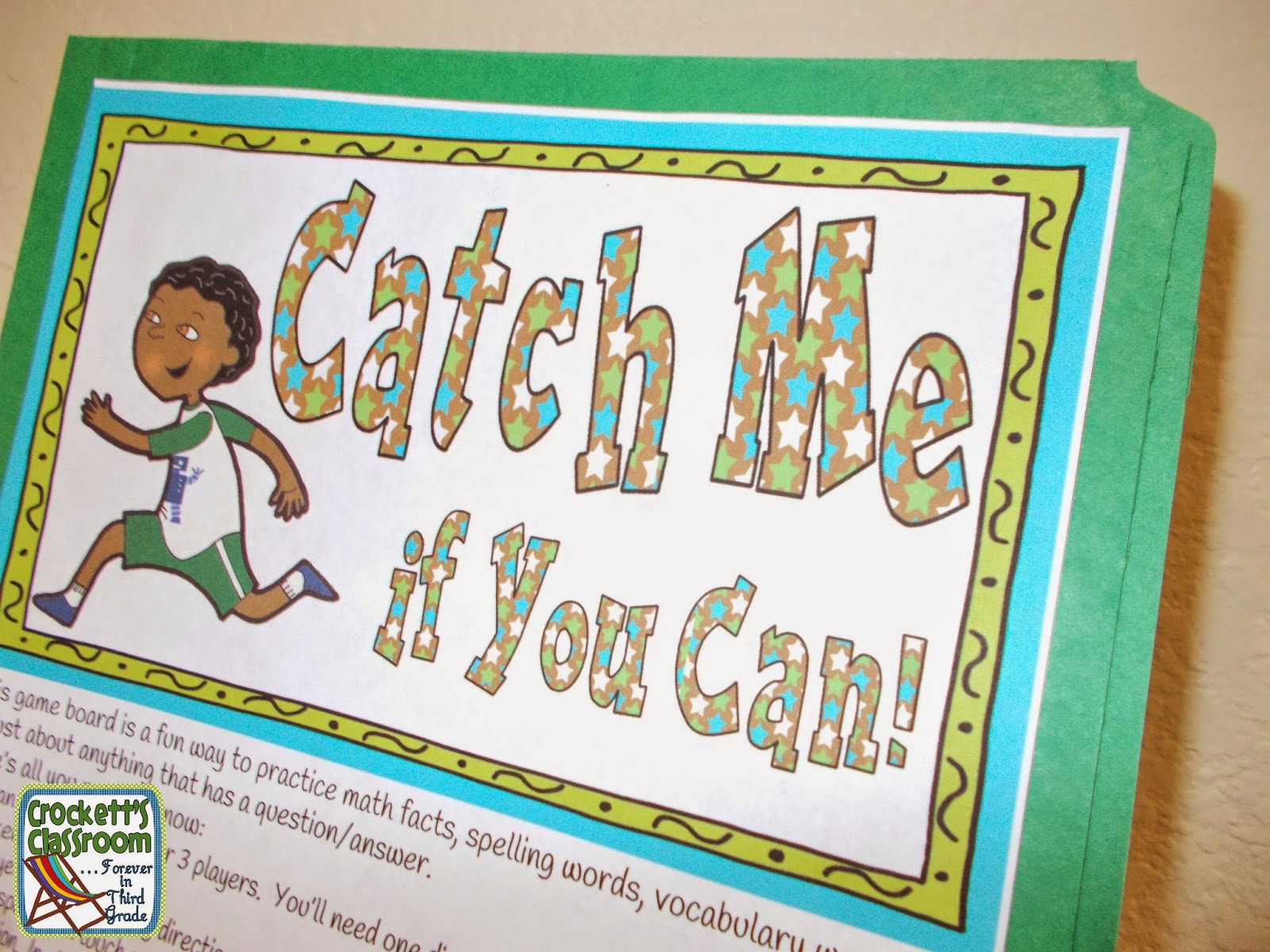
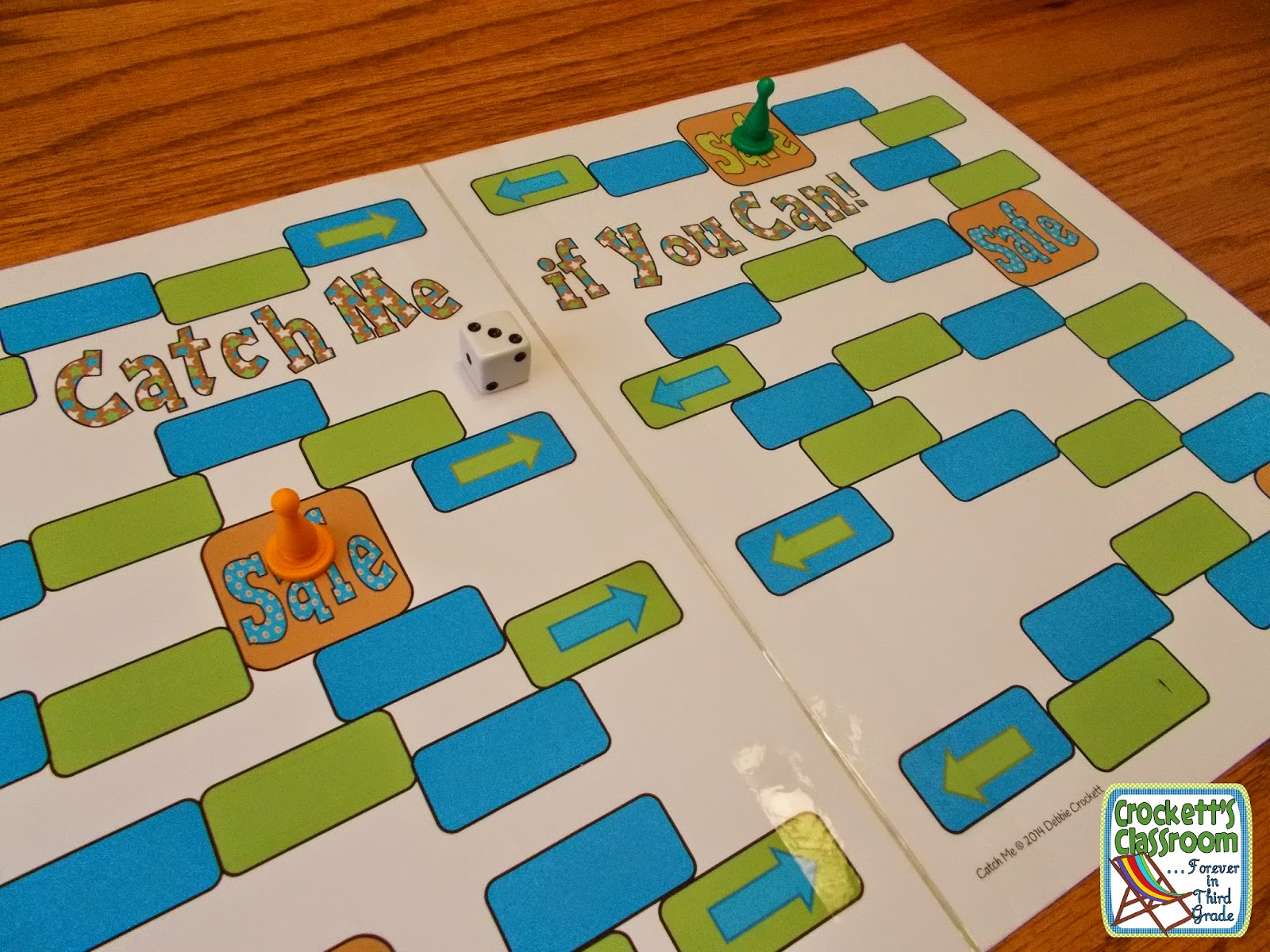
Games are a great way to get kids to practice the facts.  This game, Catch Me if You Can, is super fun and can be used with any skill practice.
 Catch Me if You Can--Crockett's Classroom

Students answer questions and then move around the board trying to "catch" the other player. Click on the pictures to download your free copy.
 This super simple game can be used to review math facts, spelling words, or any other academic skill.  It's also a fun way to spice up your task cards.


Need more ideas for how to teach strategies?  Math Strategies to use everyday  has ready to go signs and practice sheets to help your students gain fluency in addition, subtraction, multiplication, division, elapsed time and estimation.  Click on the cover page to see this wonderful math packet in my TPT store.

 Math Strategies for Everyday


0


your photo name

Animal Project

Wild Days in Second Grade!
Engage your students, challenge them and then watch them learn with this fun whole class project about animal habitats.

Last week I had the chance to spend a couple of days with a group of amazing group of  second graders.  Their teacher, Mrs. Q's, had to be away for some training so I stepped in as their guest teacher.  It was the perfect opportunity to give one of my newest products, Wild Animal Park, a try.   
 Wild Animal Park

The first day we learned about different habitats by looking at web sites and reading informational books from the school library.  The kids took notes in their Habitat Field Guides.  The field guide had 5 pages, one for each habitat.  There is room to write notes about the plants, animals and adaptations.


Then the kids were ready to order the animals, plants and other things they wanted to put into their habitat area.  The group had to make some difficult decisions.  They only had $500 to spend so they couldn't order everything in the catalog.    I encouraged them to order some of the optional items (gift shop, snack shack and jeep ride) because they would bring in extra income once the park opened.  It was fun listening to their reasoning and negotiating with their group members. "We can order the elephant, but we may not have enough money for the jeep ride."  

The kids put their adding and subtracting skills to good use.  They had to add up their totals and then subtract it from 500 to see if they could afford everything they wanted.

Once I had checked all of their calculations we were ready to begin designing the wild animal park.  I took a large piece of white butcher paper and divided it into 6 equal pieces.  Before I cut the pieces apart I drew a path that would lead through each section of the park.  I also wrote the word "top" at the top of each piece so the pictures would be upright when we put it back together.  

Now the "caretakers" had to make plans and draw the animals, plants, buildings and other landscape features for their park.  I found it easier for some students to draw the animals and buildings on a separate piece of paper, color them and then cut them out to glue onto the map.  Meanwhile, some students worked on the plants and landscape for the background.


They did an amazing job!  I taped all the pieces back together when they were finished and mounted it on a piece of green butcher paper.  The park map was ready for display!  I added a few signs so visitors would know the name of the park, etc. 


This took most of the two days I was guest teaching in their class.  I'm going to be in their class again on Monday so the park will open and we'll start using the Daily Cards that tell about the income and expenses for the park.  Students will be keeping the financial records each day the park is open. More math skill practice!  Yea! 


0


your photo name

Fraction Circle Fun


This is a great way to give kids experience with fraction pieces and end up with an adorable piece of art.  The idea for the fraction circle pictures comes from the book Picture Pie by Ed Emberley. The book has so many ideas of birds, animals, insects and plants that can be made from fractional pie pieces.
http://www.hachettebookgroup.com/titles/ed-emberley/ed-emberleys-picture-pie/9780316789820/


First decide what fractions you want your students to use.  Halves, fourths and eighths can be made from plain circles.  You can show students how to fold and cut the circles to get those fractions. 
If you want them to use thirds, and sixths it is much easier to start with preprinted circles. 

Click on the fraction circles for a pdf file that you can print for your class to use on this or other projects.
The students in Mrs. Q's class used white circles and then colored them for their completed pictures.  But I've done this in the past with circles printed on colored construction paper.

When the pictures are finished you can have them write statements about how many fractions they used for their picture. 


For example, for this picture the student  could write:
sun = 1 + 8/8 = 2 circles
flower = 1/2 + 2/4 = 1 circle
leaves = 2/8


Here's another example:
sun = 1/4
butterfly = 4/8
flower = 4/8
cardinal = 1/2 + 2/4 + 1/8


The kids had a lot of fun and gained some great experience with fractions.  
Thank you to Mrs. Q's second graders for letting me use their fraction art.  They are a very talented group of boys and girls.


2


your photo name
Back to Top